
TL;DR:
- Extended motorcycle touring presents risks such as flat tires, drivetrain failures, and ergonomic fatigue that can jeopardize safety and trip continuity. Proper preparation—including mechanical checks, ergonomic setup, navigation redundancy, weather awareness, and mindful packing—significantly mitigates these challenges. Successful riders prioritize realistic planning, disciplined stops, and mindset resilience, making manageable obstacles into safe and enjoyable adventures.
Planning an extended motorcycle tour feels incredible until the first flat tire leaves you stranded on a remote stretch of highway, or until a sudden thunderstorm rolls in with nowhere to shelter. The common motorcycle touring challenges that catch riders off guard are rarely the dramatic ones. They are the slow-building mechanical issues, the subtle ergonomic problems, and the navigational gaps that compound over miles into something that can cut a trip short or become genuinely dangerous. This guide covers what actually goes wrong, why it happens, and what you can do to keep your ride on track.
Table of Contents
- Key takeaways
- 1. Common motorcycle touring challenges start with flat tires
- 2. Chain wear and drivetrain failures on the road
- 3. Suspension wear under touring loads
- 4. GPS failures and navigational dead zones
- 5. Rider fatigue driven by ergonomic setup
- 6. Mental fatigue and its effect on decision-making
- 7. Riding in adverse weather conditions
- 8. Dangerous times to ride and traffic patterns
- 9. Heavy packing, weight distribution, and handling
- 10. Fuel management and consumption on tour
- My take on what riders consistently underestimate
- Plan your next ride with the Bikerslifestyle community
- FAQ
Key takeaways
| Point | Details |
|---|---|
| Mechanical prep is non-negotiable | Flat tires and chain failures are the top causes of breakdowns; carry repair tools and do a pre-tour service. |
| Ergonomic fatigue is systemic | Poor seat and handlebar setup causes tension across the whole body, not just soreness at one contact point. |
| Navigation needs redundancy | GPS failure mid-route is common; always carry offline maps and know your fuel range. |
| Weather data saves rides | Riding in rain, fog, or high winds multiplies crash risk; plan around forecasts before you leave. |
| Mental fatigue is the hidden danger | Calm, methodical thinking at every stop prevents panic-driven mistakes on remote routes. |
1. Common motorcycle touring challenges start with flat tires
Nothing derails a tour faster than a flat on a road with no cell signal and no gas station in sight. Riders on extended tours experience one to two flats per week on average, making roadside repair one of the most critical skills you can develop before you leave home.
The difference between a flat that costs you thirty minutes and one that ruins your day comes down to what you are carrying. At minimum, your kit should include:
- A portable tire plug kit or tubeless repair plugs
- A CO2 inflator or compact hand pump
- Tire levers and a valve core tool
- A spare tube if your bike runs tubed tires
Knowing how to use these tools under pressure is just as important as owning them. Practice a full tire change in your driveway before the tour. It feels tedious, but you will be grateful the first time you do it on a gravel shoulder in the rain.
Pro Tip: If you are touring on a tubeless setup, carry both plug kits and a small canister of tire sealant. Plugs handle punctures from nails and screws, while sealant buys you time for slower leaks from road debris.
2. Chain wear and drivetrain failures on the road
Drivetrain problems affect roughly 60% of tourers on extended trips, with chain failures and broken spokes ranking among the most common causes of breakdowns. A worn chain does not just stretch. It accelerates sprocket wear and can snap under load on a hill climb or in heavy traffic, both of which are terrible situations.
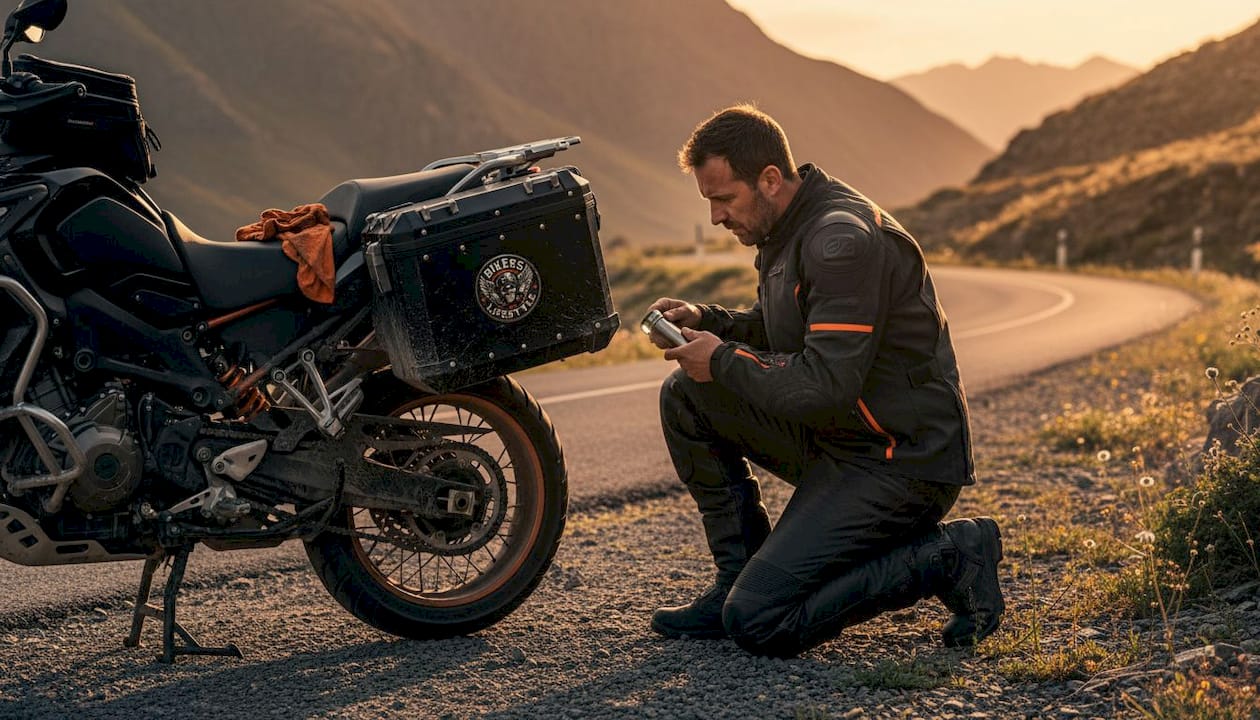
Before any long trip, measure your chain with a chain wear indicator tool. If it is at or past the replacement mark, change the chain and both sprockets together. Replacing one without the other shortens the life of everything you just installed.
On the road, clean and lubricate your chain every 500 miles or after riding in rain. Wet conditions wash lubricant away faster than most riders expect. Carry a small bottle of chain lube in your toolkit so you can do a quick application at any fuel stop.
| Maintenance Item | Interval | Touring Condition Adjustment |
|---|---|---|
| Chain lubrication | Every 500 miles | Every 200 miles in wet conditions |
| Chain wear check | Every 1,500 miles | Every 750 miles with heavy luggage |
| Sprocket inspection | Every 5,000 miles | Inspect at each chain replacement |
| Drive belt tension | Per manual spec | Check after first 300 touring miles |
3. Suspension wear under touring loads
Adventure and touring bikes are built for loaded riding, but that does not mean their suspension handles it indefinitely without attention. Suspension servicing is recommended every 15,000 to 20,000 km under normal conditions. Under harsh touring loads, that interval shortens considerably.
The symptom most riders notice first is a harsh, jarring ride over bumps that previously felt manageable. What is actually happening is that fork oil has degraded, damping has become inconsistent, and your rear shock is likely bottoming out under the added weight of luggage. Ignoring it does not just hurt comfort. It affects how the bike steers and brakes.
Before your tour, adjust suspension preload to account for loaded weight. Most bikes have a preload adjuster on the rear shock that you can turn by hand or with a simple spanner. Set it for solo riding with luggage or two-up with gear, not for unloaded riding. It takes ten minutes and meaningfully changes how the bike handles over the first hundred miles.
4. GPS failures and navigational dead zones
GPS is reliable until it is not. Signal drops in mountain canyons, tunnels, and thick forest corridors happen without warning. Road closures from construction, flooding, or seasonal restrictions do not update in real time on most consumer navigation apps. Depending entirely on one navigation source is one of the most common motorcycle trip difficulties that experienced tourers warn against.
The practical solution is layering. Use your primary GPS unit or phone-based navigation, but back it up with:
- A downloaded offline map through an app like Maps.me or Google Maps offline mode
- A paper or laminated cue sheet for the day's route segment
- A basic physical map of the region you are riding through
Know your fuel range before you leave each morning. Many rural roads between services stretch 80 to 100 miles, and not all of them appear as warnings on GPS apps. Calculate your bike's realistic range at touring speed with luggage, not the optimistic figure from the spec sheet.
Pro Tip: Screenshot your day's route in segments and save them to your phone's camera roll. When your navigation app crashes or loses signal, you can reference those images offline without needing data or a working GPS lock.
5. Rider fatigue driven by ergonomic setup
Most riders blame fatigue on long hours in the saddle. The real culprit is usually the saddle itself, along with handlebar reach and footpeg height. Poor ergonomic setup creates systemic fatigue through chain reactions in posture. When your seat pitch is wrong, your pelvis tilts forward, which tightens your hip flexors, which loads your lower back, which tenses your shoulders. By hour four, you are exhausted, and no amount of stretching at a rest stop fully resets it.
The most common ergonomic problems and their fixes look like this:
- Seat too hard or pitched forward: Creates pelvic instability and lower back loading. A gel pad or aftermarket seat with the right pitch makes a measurable difference.
- Handlebars too far forward: Forces you to lean and lock your elbows, which vibrates tension into your shoulders and neck. Bar risers or different bars can solve this for under $100.
- Footpegs positioned wrong: High pegs load your knees, low pegs create hip flexor tension. Adjustable pegs or highway pegs for secondary positioning help on long straights.
Hydration and planned rest stops are not optional on tours over four hours. Dehydration sets in before you feel thirsty, and once you are behind on fluids, your concentration drops and your reaction time suffers. Stop every 90 minutes, drink water, and move around.
Pro Tip: On long straight sections, shift your weight side to side every twenty minutes. Consciously drop each shoulder and roll your neck. These micro-adjustments redistribute tension before it accumulates into the kind of stiffness that affects your riding.
6. Mental fatigue and its effect on decision-making
Physical tiredness is visible. Mental fatigue is quieter and more dangerous because you rarely notice it developing. After six or seven hours of routing decisions, traffic monitoring, and constant environmental scanning, your brain is working at a fraction of its fresh capacity. The decisions you make in this state, whether to push through to the next town, to pass a slow vehicle on a curve, or to assess a mechanical noise, carry significantly higher risk.
The fix is not heroic. Stop when you planned to stop. If something goes wrong mechanically on a remote route, the calm, methodical troubleshooting approach consistently produces better outcomes than reacting from a place of stress or urgency. Experienced tourers treat every stop as a mental reset, not just a fuel or food break.
When you are genuinely road-fatigued, your instinct will be to "just get to the next town." Resist it. The risk in that final exhausted stretch is higher than the inconvenience of stopping early.
7. Riding in adverse weather conditions
Rain, fog, and high winds do not just make riding unpleasant. They fundamentally change the physics of what your bike is doing on the road. Rain, fog, and high winds elevate crash risk substantially, with the added variable of reduced visibility from other drivers who are not watching for motorcycles.
Temperature extremes create their own challenges. Cold stiffens tires and reduces grip during the first few miles. Heat degrades tire pressure and rider concentration over long exposures. Both require active management, not just a hope that conditions improve.
For riding in adverse weather, the gear that matters most:
- Rain gear: A quality two-piece waterproof suit worn over your riding gear, not instead of it. Hypothermia from sustained wet riding is a real risk, even in summer.
- Fog and low light: A high-visibility vest over your jacket and a clear or yellow visor instead of tinted. You need to be seen as much as you need to see.
- High wind: Reduce speed, widen your following distance, and be especially aware of crosswind exposure on bridges and open highway sections.
Pro Tip: Check a dedicated weather service like Weather Underground or Windy.com the evening before each riding day. These tools show wind speed and direction at road level, not just general forecasts, which makes a significant difference when planning high-elevation or coastal routes.
8. Dangerous times to ride and traffic patterns
The data on when crashes happen is specific and worth knowing. Accident risk peaks between 7 and 9 a.m., 4 and 7 p.m., and 9 p.m. and 3 a.m., driven by commuter traffic volume in morning and evening windows and impaired drivers in the late night hours. Holiday weekends concentrate these risks further.
If you are planning a multi-day tour, build your daily schedule around these windows. Starting at 6 a.m. and stopping by early afternoon keeps you out of the most dangerous traffic window. If you ride in mountain or desert terrain, the early start also gives you cooler temperatures in the morning before afternoon heat builds.
Rural roads are not necessarily safer. Low traffic often creates a false sense of security that increases riding speed, reduces alertness, and removes the safety net of nearby help if something goes wrong.
9. Heavy packing, weight distribution, and handling
Loading a bike improperly is one of the long distance riding problems that shows up slowly. You notice something feels slightly off in corners, then slightly more off on the highway. By the time you trace the handling issue back to weight distribution, you may have been riding with degraded stability for days.
The principles of smart packing are straightforward:
- Keep the heaviest items low and centered, close to the bike's center of gravity
- Distribute weight evenly between left and right panniers to within a few pounds
- Avoid strapping soft luggage high on a tail rack. It raises the center of gravity and creates a pendulum effect in crosswinds
- Weigh your bags before you leave home. Most bikes have a rated load capacity that is easier to exceed than riders expect
Pro Tip: Pack your heaviest items, tools, water, spare parts, directly in tank bags or low pannier sections. Clothing and lightweight camping gear go on top and at the back. This single change improves handling more visibly than most riders expect.
10. Fuel management and consumption on tour
Fuel consumption changes significantly on a loaded touring bike compared to everyday riding. Added weight, higher average speeds, and sustained highway riding all shift your real-world range away from what the gauge suggests. Running out of fuel on a remote route is one of those motorcycle travel obstacles that feels avoidable until it happens to you.
Track your consumption over the first two days of any tour and adjust your mental range accordingly. A bike that delivers 50 miles per gallon around town may deliver 38 on a loaded touring run at 70 mph. That gap can easily be the difference between making it to the next station and not.
Know where fuel stops are on your route, and refuel at every opportunity when you are in a region with limited services. A half-tank stop costs you five minutes. Running dry costs you hours.
My take on what riders consistently underestimate
I have been watching riders plan tours for years, and the pattern that shows up most often is this: people over-prepare for the dramatic scenarios and under-prepare for the slow-building ones. They pack a first aid kit for a crash but do not check their seat pitch before 500 miles of riding. They download a GPS app but do not know their bike's real fuel range.
The ergonomic fatigue issue is one I feel strongly about because it is so preventable and so consistently ignored. Experienced riders know that seat pitch and handlebar reach create tension patterns across the whole body that stretching at a rest stop cannot fully undo. Getting these things right before you leave home is not a comfort upgrade. It is a safety decision.
The mental fatigue piece matters just as much. I have seen riders on remote routes make genuinely poor calls, like continuing on a sketchy road surface in fading light, because they were too mentally drained to properly assess the situation. Resetting calmness at each stop, actually stepping away from the bike, breathing, and reviewing the next segment, costs five minutes and changes the quality of every decision you make afterward.
The riders who handle touring challenges best are not the ones with the most gear. They are the ones who have honest expectations, a prepared bike, and the discipline to stop when the plan says to stop. The challenges are real. They are also almost all manageable with the right preparation and mindset.
— Trevor
Plan your next ride with the Bikerslifestyle community
Dealing with the common motorcycle touring challenges covered here becomes a lot more manageable when you are riding with people who have been through them. Bikerslifestyle connects riders with events, groups, and routes that make extended touring richer and more social. Whether you want to join the 2026 European Motorcycle Rally and ride with thousands of enthusiasts across incredible terrain, or you want to find a local riding group that can offer route knowledge and on-road support, the platform has what you are looking for. You can also browse curated scenic rides to build your next route around roads worth the distance. Bikerslifestyle makes finding your people part of the ride.
FAQ
What are the most common mechanical failures on motorcycle tours?
Flat tires are the single most frequent mechanical issue, with 85% of tourers reporting them. Chain and drivetrain failures follow closely, making pre-tour inspection and a basic repair kit non-negotiable.
How do you manage fatigue on a long motorcycle ride?
Stop every 90 minutes, drink water at each break, and address ergonomic issues before your trip rather than managing soreness on the road. Hydration and regular stops directly reduce fatigue and maintain concentration.
When is it most dangerous to ride a motorcycle?
Risk is highest between 7 and 9 a.m., 4 and 7 p.m., and 9 p.m. and 3 a.m. due to traffic density and impaired drivers at night. Holiday weekends and adverse weather conditions compound these risks further.
What should you do if your GPS fails on a remote route?
Switch to an offline map app you downloaded before leaving, reference route screenshots saved to your camera roll, and use a physical map of the region as a backup. Planning fuel stops and distances without GPS reliance is a core touring skill.
How does heavy packing affect motorcycle handling?
Excess weight loaded too high or unevenly between panniers raises the center of gravity and creates instability in corners and crosswinds. Keep the heaviest items low and centered, and weigh your bags before departure to stay within the bike's rated load capacity.