
TL;DR:
- Motorcycle clubs have a strict hierarchical structure resembling military chains of command, with roles like President and Road Captain serving specific functions. Membership progresses through stages from hangaround to full patch, symbolizing loyalty and earned status with significant patches signaling territorial claims. Club governance is maintained through bylaws, meetings, and enforced discipline, emphasizing respect and accountability rather than power or popularity.
Most people looking at a motorcycle club from the outside see a group of riders in matching vests. What they miss is the entire organizational system underneath those vests. Motorcycle club hierarchy explained properly reveals something much closer to a military chain of command than a casual riding group. Every title has a function, every patch carries a meaning, and every stage of membership is earned through demonstrated loyalty. Whether you are curious about the culture or planning to join a club, understanding these structures changes how you see the whole world of organized riding.
Table of Contents
- Key takeaways
- Motorcycle club hierarchy explained: the core officer positions
- From hangaround to full patch: the membership path
- What patches and rockers actually communicate
- How clubs govern themselves and maintain order
- My take on what respect actually means in club culture
- Get connected to the riding community
- FAQ
Key takeaways
| Point | Details |
|---|---|
| Structured chain of command | Every MC operates with defined positions from President down to Road Captain, each carrying specific duties. |
| Membership is earned in stages | Riders move from hangaround to prospect to full-patch member over months or years of demonstrated loyalty. |
| Patches signal status and territory | A three-piece patch identifies a full MC, with the bottom rocker claiming a specific geographic territory. |
| Bylaws govern behavior | Clubs enforce conduct through written bylaws, and the Sergeant-at-Arms controls order at every meeting. |
| MCs differ from riding clubs | The MC designation carries strict protocol and territorial rights that informal riding clubs do not claim. |
Motorcycle club hierarchy explained: the core officer positions
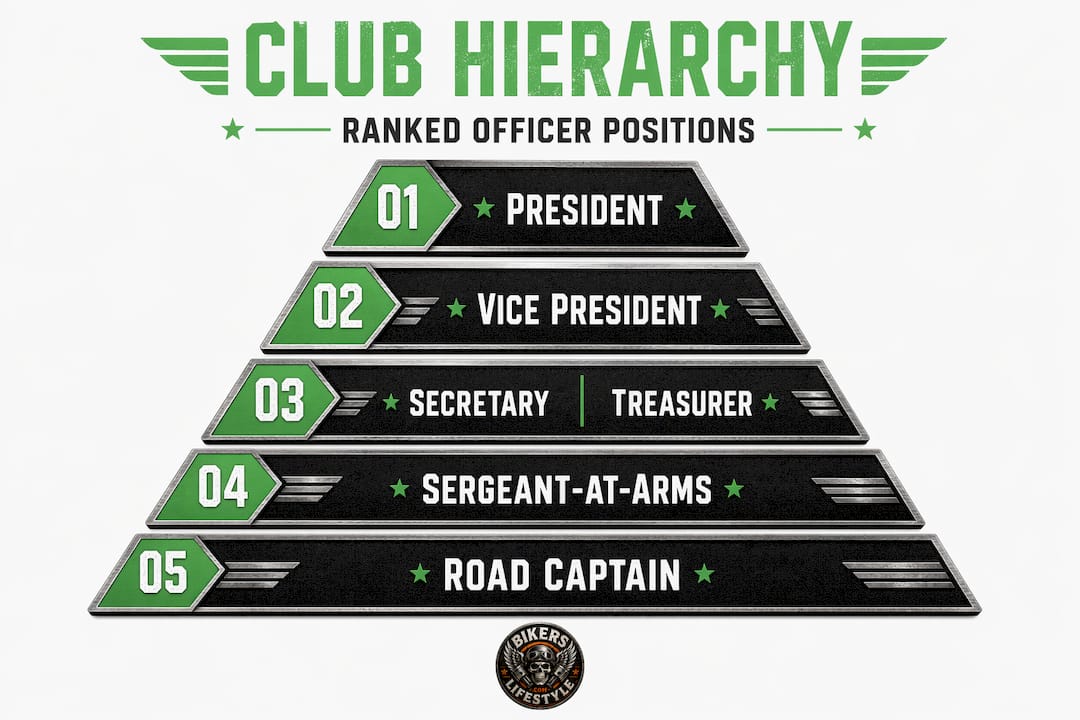
The standard MC hierarchy consists of six foundational positions: President, Vice President, Secretary, Treasurer, Sergeant-at-Arms, and Road Captain. Each role exists for a reason, and the chain of command is taken seriously by every member.
President
The President is the final authority on club decisions. This person sets direction, represents the club in dealings with other MCs, and handles any conflict that escalates beyond the capacity of other officers. Being President is not a popularity contest. It demands political skill, physical credibility, and the kind of consistent judgment that other members can trust under pressure. Most Presidents earned the role after years of membership, which means the respect behind the title is real before the title ever gets used.
Vice President
The Vice President functions as the second in command and serves as the internal liaison between the President and the general membership. When the President is absent, the VP runs meetings and makes time-sensitive calls. In many clubs, the VP also acts as the club's public-facing communicator, managing relationships with allied chapters or neutral clubs. Think of this role as the operational layer that keeps daily club life functional while the President handles the bigger picture.
Secretary and Treasurer
These two positions handle the administrative backbone of the club. The Secretary maintains meeting records, manages correspondence, and tracks membership status. The Treasurer controls club finances, collects dues, and manages any shared funds tied to events or properties. Both roles require trust above almost everything else, since they hold access to sensitive club information. Sloppy record-keeping or financial mismanagement are fast ways to lose standing in a club that runs on honor.
Sergeant-at-Arms
This is one of the most misunderstood positions from the outside and one of the most respected from within. The Sergeant-at-Arms enforces bylaws and controls order during meetings. This officer decides who speaks, when, and for how long. Beyond meetings, the role covers personal security for club officers, discipline for members who violate conduct rules, and enforcement of patch protocol. It is not a ceremonial position. Clubs that have weak enforcement in this role often fracture over time.

Road Captain
The Road Captain plans and leads group rides. This covers route scouting, safety planning, fuel stop coordination, and managing rider formation on the road. For large clubs that ride together regularly, this is a logistically demanding job. A good Road Captain keeps rides organized and incident-free, which matters both for safety and for the club's reputation with law enforcement and the public.
Pro Tip: If you are researching a club before approaching it, pay attention to how current members talk about their officers. Respect for leadership is a strong indicator of club health and long-term stability.
The motorcycle gang hierarchy across all club types is maintained through clear roles, mutual respect, and consistent enforcement of those roles. Clubs that let titles become ceremonial tend to lose internal cohesion fast.
From hangaround to full patch: the membership path
Joining a real MC is nothing like signing up for a recreational club. The process is deliberate, long, and designed to filter out anyone who is not genuinely committed to the group's values.
-
Hangaround. This is the first informal stage. A hangaround attends club events, socializes with members, and gets a feel for the culture without any official standing. The club is watching just as much as the candidate is. This phase has no set timeline and no formal requirements. It ends when members decide whether to invite the person into the next stage or quietly stop including them.
-
Prospect. Once a member sponsors a hangaround and the club votes to accept, the candidate becomes a prospect. The prospecting period typically lasts between 6 and 18 months. During this time, prospects perform tasks that range from unglamorous to demanding: cleaning the clubhouse, running errands, standing guard at events, and being available when the club needs something done. Prospects wear a partial patch showing the club name but not the full colors. They attend meetings but cannot vote.
-
Full-patch member. After the prospecting period, the club holds a vote. Every full-patch member has a say, and a single negative vote can reject a prospect regardless of how long they have been working toward membership. This is not dramatic. It reflects the high trust standard required to call someone a brother. When the vote passes, the new member receives their full patch and all the rights and responsibilities that come with it. They can vote, speak freely in meetings, hold office, and represent the club.
The patch ceremony itself carries significant weight. Earning full colors is treated as a milestone comparable to military promotion in some clubs. The member is expected to wear the patch with pride and defend both the patch and the club's reputation publicly.
Pro Tip: Never ask a prospect how long they have been prospecting or when they expect to patch in. It signals that you do not understand club culture, and it puts the prospect in an awkward position.
Understanding motorcycle club ranks through this membership lens matters because it reframes what the patches actually mean. They are not decorations. They are records of what someone went through to earn standing.
What patches and rockers actually communicate
Walk up to a patched MC member and you are looking at a visual language that communicates club identity, status, and territorial claim all at once. Knowing how to read that language is part of understanding motorcycle club structure.
Three-piece vs. one-piece patches
| Patch Type | Who Wears It | What It Signals |
|---|---|---|
| Three-piece (top rocker, center patch, bottom rocker) | Full MCs | Established club with territorial claim and strict protocol |
| One-piece patch | Riding clubs, casual groups | Social or recreational riding, no territorial claim |
| Two-piece patch | Some MCs in development | Club working toward full MC status, not yet claiming territory |
The three-piece patch identifies a fully patched MC and is the most recognized symbol in club culture. The top rocker carries the club name. The center patch displays the club's logo or emblem. The bottom rocker specifies the geographic territory the club claims as its own.
The bottom rocker and territorial protocol
The bottom rocker is where things get serious. Territorial claims are not abstract. They represent physical presence, relationships with other clubs, and sometimes formal agreements about who operates where. Wearing a bottom rocker without permission from the dominant club in a given area is one of the fastest ways to create a confrontation. This is not a rule written down in a public handbook. It is enforced by the clubs themselves through protocol that every serious MC understands.
Riding clubs and casual groups wear one-piece patches specifically to signal that they are not making territorial claims. The MC designation signals earned status with specific territorial rights that come with obligations and potential friction. Choosing that designation is a deliberate decision, not a style choice.
Some additional patch elements worth knowing:
- 1% patch: Worn by clubs that identify as operating outside mainstream society. This is a deliberate identity marker, not a universal criminal label.
- MC rockers: Only clubs that have gone through the formal process of being recognized wear "MC" on their vest. Using it without recognition is treated as disrespectful.
- Support patches: Smaller patches indicating affiliation with or support for a larger, well-known club. These carry their own protocol around use and display.
How clubs govern themselves and maintain order
A motorcycle club with no governance structure is just a group of people with matching shirts. What separates a real MC from that is a written set of rules and the enforcement mechanisms to back them up.
Club bylaws serve as the binding legal and cultural document of the organization. They define membership requirements, officer duties, grounds for suspension or expulsion, financial management rules, and the procedures for conducting official votes. Members are expected to know the bylaws and follow them without needing to be reminded.
The formal club meeting, universally known as "church," is where governance becomes visible. Church follows strict protocols with the Sergeant-at-Arms managing participation and protocol adherence throughout. Only patched members attend. Phones are often prohibited. Votes are taken on club business ranging from accepting new members to making decisions about events, alliances, and discipline.
"Hierarchy is maintained through mutual respect and strict adherence to bylaws, with the Sergeant-at-Arms enforcing discipline and loyalty." ShunAuto
When violations occur, the process for handling them is internal. Minor infractions might result in a formal reprimand or temporary suspension of privileges. Serious violations can lead to expulsion and the requirement to return the patch. The patch belongs to the club, not the individual. That distinction matters more than most outsiders realize.
For clubs with multiple chapters, the mother chapter exerts authority over regional and national chapters, collecting dues and resolving disputes to maintain organizational consistency. The national president of the mother chapter functions similarly to a corporate headquarters, setting overall direction while allowing local chapters some operational autonomy. You can explore how motorcycle groups operate across regions and find local chapters through community platforms built for riders.
The roles in motorcycle clubs at the governance level exist because these organizations need to function consistently over time. Without structure, personal conflicts derail the whole group. With structure, even disagreements have a process.
My take on what respect actually means in club culture
I have spent years around motorcycle culture, reading deeply into club history and talking with riders who have been through the process. One thing I keep coming back to is how often outsiders focus on the titles and miss the actual mechanism holding clubs together: earned respect.
The President of a club is not respected because of the title. The title came because the respect was already there. I have seen this pattern play out consistently. Officers who lean on their position to get compliance tend to create fragmented clubs. Officers who would have compliance even without the title tend to build something that lasts.
The membership stages reinforce this completely. A club that lets someone skip the prospecting period, even for practical reasons, usually regrets it. The prospecting period is not hazing for its own sake. It is the mechanism by which a group of people with strong personalities and independent streaks decide whether someone shares their values under pressure. That process cannot be shortcut without cost.
What strikes me about how motorcycle clubs operate is that the structure is genuinely functional, not ceremonial. The Road Captain keeps people safe on rides. The Secretary keeps the club legally organized. The Treasurer prevents money from disappearing. These are real organizational problems that the hierarchy solves.
My honest observation is that the biggest misconception people carry into this world is the idea that the hierarchy is about power for its own sake. From what I have seen, the clubs that last are the ones where the hierarchy is about accountability. Every officer answers to the membership. Every member answers to the bylaws. That circular accountability is the actual foundation. Beyond that, if you want to understand biker brotherhood at a deeper level, the structure we have covered here is only the starting point.
— Trevor
Get connected to the riding community

Understanding how motorcycle clubs operate is one thing. Experiencing the culture firsthand is another. Bikerslifestyle brings riders together through a platform built specifically for this community. Whether you want to find upcoming rallies, connect with local riding groups, or discover scenic routes you have never ridden, the resources are all in one place. Check out the Red White and Bikes Rally Series for one of the most recognized rally events in the community, or browse the Vintage Motorcycle Showcase to see the machines that shaped club culture. For everything from local rides to major events, the Bikerslifestyle community hub is where the riding world connects.
FAQ
What are the main positions in a motorcycle club?
The core positions in most MCs are President, Vice President, Secretary, Treasurer, Sergeant-at-Arms, and Road Captain. Each role carries specific duties that keep the club organized and accountable.
How long does it take to become a full-patch member?
The prospecting period typically lasts between 6 and 18 months, during which candidates perform tasks for the club and demonstrate loyalty before being voted on by current full-patch members.
What does a three-piece patch mean on a vest?
A three-piece patch identifies a fully patched motorcycle club, with the top rocker showing the club name, the center patch displaying the logo, and the bottom rocker claiming a specific geographic territory.
What is "church" in motorcycle club culture?
Church is the term for official club meetings, where only full-patch members attend, votes are taken on club business, and the Sergeant-at-Arms enforces meeting protocols and order.
What is the difference between an MC and a riding club?
An MC, or motorcycle club, uses a three-piece patch, follows strict territorial protocols, and operates with a formal hierarchy. A riding club typically wears a one-piece patch and functions as a social group without territorial claims or the same level of formal structure.