
TL;DR:
- A motorcycle run sheet is a live operational document that maps every activity of a group ride, including times, locations, and responsible individuals. It distinguishes itself from cuesheets, which provide turn-by-turn navigation, by focusing on event flow and safety, thereby enhancing coordination and reducing chaos. Proper preparation, clear role assignment, and physical backups are essential for ensuring a smooth, safe, and well-managed ride.
A motorcycle run sheet is the operational document that maps every moment of a group ride or event, from the first rider briefing to the final pack-down, assigning times, locations, durations, and responsible individuals to each activity. Unlike a general itinerary, it functions as a live decision-making tool that keeps organizers in control when conditions change mid-ride. The industry term you'll also hear is "event run sheet," borrowed directly from professional event management and adapted for the specific demands of motorcycle culture. Whether you're coordinating a 10-rider charity run or a 200-person rally, understanding this document is the difference between a smooth ride and a chaotic one.
What a motorcycle run sheet explained looks like in practice
A well-built motorcycle run sheet maps every moment from departure to pack-down and organizes that information into five core columns: Time, Activity/Item, Duration, Location, and Responsible Party. Each column carries specific weight. The Time column anchors the entire document, giving every participant a shared reference point. The Responsible Party column is where most organizers underinvest, leaving tasks without clear ownership and creating confusion when something goes wrong.

Here is what a basic motorcycle run sheet structure looks like in table form:
| Time | Activity/Item | Duration | Location | Responsible Party |
|---|---|---|---|---|
| 8:00 AM | Rider registration and check-in | 30 min | Main parking lot | Registration Lead |
| 8:30 AM | Safety briefing and route overview | 20 min | Staging area | Ride Captain |
| 8:50 AM | Fuel check and gear inspection | 10 min | Staging area | Sweep Rider |
| 9:00 AM | Departure | Rolling | Highway 1 North | Lead Rider |
| 10:30 AM | First regroup stop | 20 min | Ridgeline Diner, Mile 47 | Sweep Rider |
| 12:00 PM | Lunch stop (hard stop) | 45 min | Canyon Creek Grill | Ride Captain |
| 2:30 PM | Final destination arrival | N/A | Riverside Fairgrounds | All |
The Notes column, which many templates omit, is where you record dependencies and cues. For example, a note might read: "Departure only after sweep rider confirms full group at staging." That single line prevents a lead rider from pulling out while three bikes are still in the parking lot.
Pro Tip: Add 10 to 15 minutes of buffer time after every major stop. Group rides consistently run longer than solo rides because of the time it takes to regroup, refuel, and get everyone moving again. Build that reality into your document from the start.
The table format is not decorative. It forces you to think in specifics rather than approximations, and it gives every team member a scannable reference they can check in seconds without reading a paragraph of prose.
How does a run sheet differ from a cuesheet?
The confusion between these two documents is one of the most common mistakes new ride organizers make. A cuesheet is a turn-by-turn navigation document for riders on the road. It lists road names, distances, turn directions, and landmarks. A run sheet manages event flow and people. Mixing the two overwhelms organizers and riders by forcing them to process navigation data and scheduling data from the same page at the same time.
Here is a direct comparison of both documents:
| Feature | Run Sheet | Cuesheet |
|---|---|---|
| Primary user | Event organizer, ride captain | Individual rider |
| Core content | Times, activities, roles | Turns, distances, landmarks |
| Format | Chronological table | Sequential navigation list |
| Used when | Before and during event management | While riding on the road |
| Goal | Coordinate people and flow | Navigate the route accurately |
Think of it this way: the run sheet is the conductor's score, and the cuesheet is the sheet music each musician reads. Both are necessary. Neither replaces the other. A lead rider focused on navigation cannot simultaneously manage the event timeline, and an organizer managing logistics should not be squinting at turn-by-turn directions while tracking whether the sweep rider has checked in.
Separating these documents reduces cognitive load for the lead rider and allows focused navigation and event management to happen in parallel rather than in conflict.
Pro Tip: Print and laminate separate physical copies of each document. Give the cuesheet to every rider and the run sheet to key staff only. Handing a 20-line run sheet to a rider who just wants to know when to turn left creates confusion before the ride even starts.
Understanding motorcycle route planning as a discipline separate from event scheduling helps organizers build both documents with the right level of detail for each audience.
Why a run sheet is critical for group safety and dynamics
Group rides introduce a specific set of operational challenges that solo rides never face. The accordion effect is the most underestimated one. As a group moves through traffic, stops, and intersections, the gap between the lead rider and the last rider grows. A group of 30 bikes that departs together can stretch across two miles of road within 20 minutes. A run sheet that accounts for this reality builds in safety-critical stops and treats them as non-negotiable hard stops rather than optional pauses.
The operational and safety benefits of a structured run sheet include:
- Role clarity. Clear leadership designations like lead rider and sweep rider, written directly into the run sheet, give every participant a defined chain of responsibility before the first engine starts.
- Expectation management. Experienced ride leaders use the run sheet to set group expectations around energy and pace, which reduces stress and keeps the ride enjoyable rather than reactive.
- Hard stops. Regroup points and fuel cut-offs marked as hard stops prevent cascading delays. If the run sheet says 10:30 AM at Ridgeline Diner is a hard stop, every rider knows the group waits there until the sweep confirms everyone has arrived.
- Real-time adaptability. A run sheet is a live decision-making tool that allows organizers to coordinate teams and adapt in real time, not a rigid contract that punishes deviation.
- Communication anchor. When a rider goes down or a mechanical issue arises, the run sheet tells every team member exactly where everyone should be and who is responsible for what response.
Understanding motorcycle group dynamics before you build your run sheet makes the document significantly more realistic. Riders who have never organized a group ride consistently underestimate how much time transitions consume.
Pro Tip: Print waterproof quick-reference run sheet cards and carry them in your tank bag or jacket pocket. Waterproofed quick-reference cards protect against device failures, rain, and direct sunlight that makes phone screens unreadable. A laminated card costs almost nothing and has saved more than a few rides from falling apart.
What are best practices for building and distributing a run sheet?
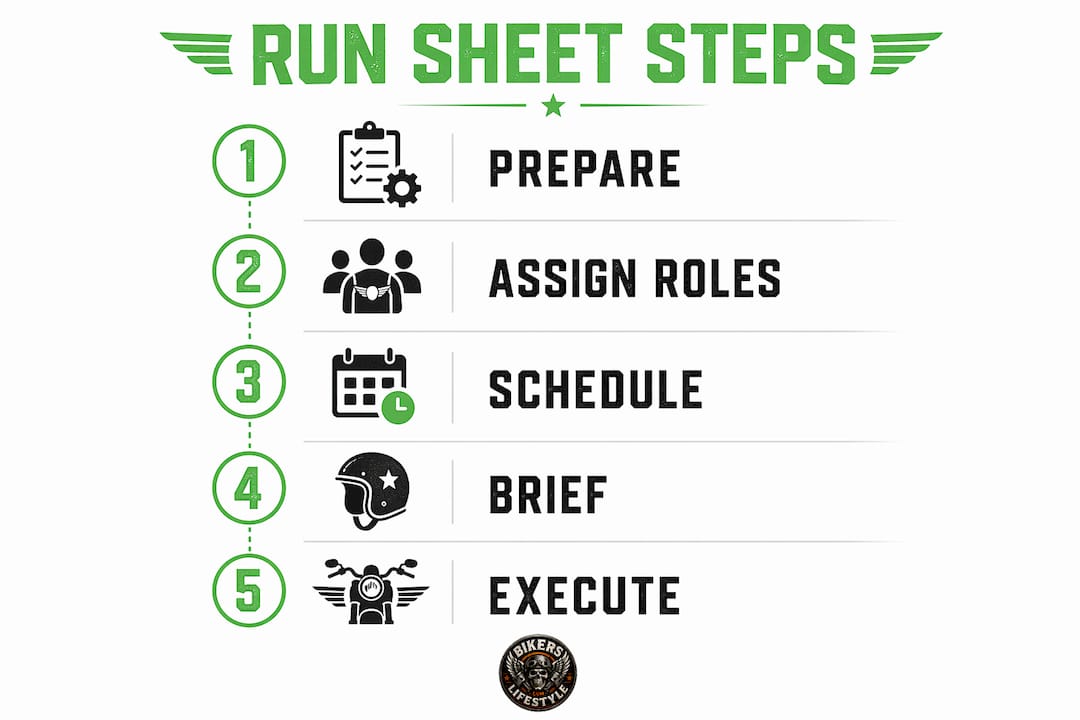
Creating a motorcycle run sheet that actually works on event day requires more than filling in a table. The process has a specific sequence, and skipping steps creates the exact problems the document is supposed to prevent.
-
Lock in key contacts and roles first. Before you write a single time into the document, confirm who is serving as lead rider, sweep rider, registration lead, and safety officer. Building the timeline without confirmed role assignments produces a run sheet that looks complete but falls apart when someone doesn't show up.
-
Build the timeline chronologically with realistic durations. List every activity in order, from pre-ride setup through post-event breakdown. Assign a duration to each item based on actual experience, not optimism. A 30-bike group takes longer to fuel than a 10-bike group. Write what is true, not what you wish were true.
-
Mark hard stops explicitly. Every regroup point, fuel stop, and safety check should be labeled "HARD STOP" in the document. This signals to all stakeholders that these moments are not negotiable and that the group does not move until the condition is met.
-
Pressure-test the run sheet before event day. Walk through the entire timeline with your key staff at least 48 hours before the event. Ask: What happens if the lunch stop runs 20 minutes long? What if a rider needs a tire change at mile 60? A run sheet that has never been stress-tested will crack under the first real deviation.
-
Distribute the right version to the right people. Organizers and team leads get the full run sheet. Riders get a simplified participant schedule that shows departure times, stop locations, and estimated arrival. Giving riders the full operational document creates questions you don't have time to answer on event morning.
-
Maintain both digital and physical formats. A shared Google Doc or Notion page works well for pre-event collaboration and last-minute updates. On the day itself, printed and laminated copies are the reliable fallback. Phones die. Cell service disappears in canyons. Paper does not.
Common pitfalls to avoid: setting departure times without accounting for a safety briefing, assigning roles to people who haven't confirmed attendance, and building a timeline based on GPS travel time without adding group transition time. The motorcycle rally checklist from Bikerslifestyle covers gear and logistics that feed directly into your run sheet timing.
Pro Tip: Send the final run sheet to all key staff no later than 24 hours before the event. Last-minute changes happen, but a 24-hour window gives your team time to internalize their responsibilities and ask questions before they're standing in a parking lot at 7:45 AM.
Key takeaways
A motorcycle run sheet is the single most effective tool for turning a planned group ride into a well-executed one, and it works because it assigns clear ownership to every moment of the event.
| Point | Details |
|---|---|
| Five core columns | Every run sheet needs Time, Activity, Duration, Location, and Responsible Party to function. |
| Run sheet vs. cuesheet | Keep these documents separate to prevent cognitive overload for riders and organizers. |
| Hard stops are non-negotiable | Label regroup points and fuel stops as hard stops to prevent cascading delays. |
| Physical backup is mandatory | Waterproof printed cards protect against device failures and poor weather conditions. |
| Pressure-test before event day | Walk through the full timeline with key staff at least 48 hours before the ride. |
Why I think most organizers underestimate this document
I've watched dozens of group rides fall apart in the first two hours, and the cause is almost always the same. The organizer had a plan in their head and a rough schedule in a text message thread. That is not a run sheet. That is a wish list.
The runs that go smoothly share one common trait: someone built a real document, shared it with the right people, and treated it as a live tool rather than a pre-ride formality. The first time I used a proper run sheet for a 40-rider charity event, the difference was immediate. When a rider had a mechanical issue at mile 35, the sweep rider knew exactly what to do, the ride captain knew exactly where the group should hold, and nobody panicked because the document had already answered the question.
What I've also noticed is that organizers scale their run sheets incorrectly. A 10-rider weekend ride does not need a 15-row table. A simplified one-page document with four key time markers and two role assignments is enough. A 150-rider rally, on the other hand, needs a full operational run sheet with sub-documents for registration, safety, and vendor coordination. The mistake is applying the same level of detail to both situations, either over-engineering a casual ride or under-preparing a major event.
The other thing most guides won't tell you: the run sheet is as much a communication tool as it is a planning tool. When you hand a team member a document that shows their name next to a specific responsibility at a specific time, you are making a commitment to them and asking for one in return. That accountability changes how people show up. I've seen it happen consistently across different types of biker meetups, from small club rides to large multi-day rallies.
Start simple. Build the habit. Then scale the document to match the complexity of your event.
— Trevor
Plan your next ride with Bikerslifestyle
Bikerslifestyle is built for exactly the kind of organizer who takes their run sheet seriously. The platform connects riders, ride captains, and event organizers with upcoming motorcycle events, scenic ride listings, and local riding groups across the country. Whether you're planning a charity run, a weekend rally, or a themed group ride, the event calendar gives you a real-time view of what's happening in your region. Use it to find inspiration, connect with experienced organizers, and build the kind of community that makes every run sheet worth writing.
FAQ
What is a motorcycle run sheet?
A motorcycle run sheet is an operational document that organizes every activity of a group ride or event into a chronological table with columns for time, activity, duration, location, and responsible party. It functions as a live planning and coordination tool for ride captains and event organizers.
How is a run sheet different from a cuesheet?
A run sheet manages event flow, roles, and timing for organizers. A cuesheet provides turn-by-turn navigation for individual riders on the road. Combining both into one document creates cognitive overload and reduces the effectiveness of each.
What should every motorcycle run sheet include?
Every run sheet should include confirmed role assignments (lead rider, sweep rider), a chronological timeline with realistic durations, explicitly labeled hard stops for regroup and fuel points, and buffer time built into each major transition.
Do I need a run sheet for a small group ride?
A simplified run sheet with four to five key time markers and two or three role assignments is appropriate for rides of 10 or fewer riders. The document scales with event complexity, but even small rides benefit from written role clarity and a confirmed departure time.
What format works best for a motorcycle run sheet?
A two-format approach works best: a shared digital document for pre-event collaboration and updates, combined with printed and laminated quick-reference cards for use on the day. Digital formats are editable; physical cards are reliable under rain, sunlight, and device failure conditions.