

TL;DR:
- Bikers attend swap meets primarily for hands-on inspection, better prices, and community connection that online markets cannot match. These events support the motorcycle culture through trusted relationships, knowledge sharing, and funding vintage programs, ensuring the hobby's sustainability. Effective participation requires early arrival, cash, preparation, and building vendor rapport to maximize value and experience.
Most people picture a dusty flea market when they hear "swap meet." Bikers know better. Why bikers attend swap meets goes far beyond hunting cheap parts on a weekend morning. These events are where rare components change hands for 30 to 50 percent below retail, where a stranger with grease under his fingernails gives you the restoration tip you've been chasing for months, and where the bonds that hold motorcycle culture together get reinforced in real time. This guide breaks down the practical, social, and economic reasons riders keep coming back, year after year.
Table of Contents
- Why bikers attend swap meets: parts, prices, and practical advantages
- Community and culture at the heart of swap meets
- Scale, legacy, and give-back initiatives that sustain the hobby
- How to maximize your swap meet experience: expert tips
- Why swap meets remain vital in the digital age: a fresh perspective
- Discover more motorcycle events and community activities
- Frequently asked questions
Key Takeaways
| Point | Details |
|---|---|
| Rare parts access | Swap meets offer hands-on access to rare motorcycle parts often unavailable or untrustworthy online. |
| Significant savings | Parts and gear at swap meets can cost 30–50% less than retail prices, making them budget-friendly. |
| Community trust | Regular interactions build trust and knowledge sharing, reducing the risk of bad purchases. |
| Event scale and legacy | Major swap meets attract thousands and support motorcycle events through proceeds. |
| Expert strategies | Arriving early and inspecting parts carefully maximize chances of finding quality deals. |
Why bikers attend swap meets: parts, prices, and practical advantages
Walk into any swap meet at 7 a.m. and you'll immediately understand something that no online listing can replicate. You're holding the part. You're running your thumb along the threads, checking for hairline cracks, fitting a gasket against a mating surface you brought specifically for that purpose. That physical verification is the core reason motorcycle swap meet veterans keep returning, and it's not nostalgia driving them there.
Buying motorcycle parts online is a gamble that experienced riders have learned to respect. Photos can be taken in flattering lighting. Descriptions can be vague or outright misleading. A carburetor listed as "good used condition" can arrive with a stripped emulsion tube that never made it into the seller's photo. Bikers attend motorcycle swap meets primarily to access parts and bikes that are hard to find online, with the in-person value coming from tactile inspection and faster, negotiation-friendly deals.
Pricing is the second major draw. Swap meet pricing runs 30 to 50 percent below retail at major events, a margin that adds up fast when you're rebuilding a bike from the frame outward. A set of carburetors, a set of fork seals, a headlight bucket, and a seat pan can easily represent several hundred dollars in savings versus buying each piece new from a dealer.
There's also the logistics angle that rarely gets mentioned. Heavy castings, frames, fenders, and fuel tanks are expensive to ship and fragile in transit. Picking them up locally at a swap meet eliminates both the shipping cost and the anxiety of opening a crate to find a cracked fin or a dented tank.
Here's what makes attending motorcycle swap meets specifically valuable for hands-on bikers and restorers:
- Physical inspection removes the guesswork that makes online buying risky for critical components
- Negotiation happens face to face, which consistently produces better outcomes than fixed online prices
- Bulk deals are possible when a vendor is moving an entire lot and wants it gone in one transaction
- Local pickup eliminates shipping costs and damage risk on large or fragile parts
- Immediate availability means you leave the event with the part in hand, not waiting two weeks for delivery
Pro Tip: Bring the specific part you're trying to match. If you need a carburetor, bring the intake manifold. If you need a brake lever, bring the perch. Vendors and fellow buyers will confirm fit on the spot, and you'll avoid the most common and costly swap meet mistake.
Having understood the practical access and economic benefits, let's explore the critical social and cultural roles swap meets play in biker communities.
Community and culture at the heart of swap meets
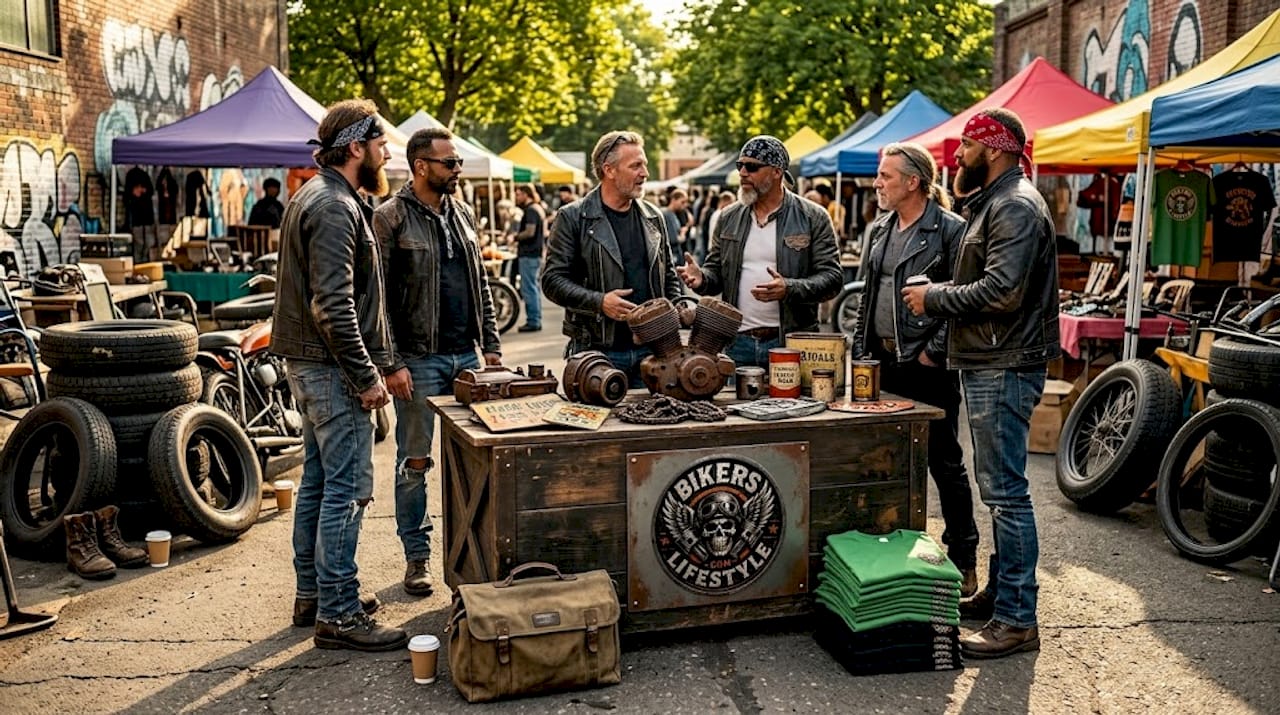
There's a reason long-time riders describe swap meets the way other people describe church or neighborhood block parties. It's not just commerce. Swap meets function as a cultural hub where riders trade parts and stories and where trust is built through repeat interactions with vendors. That trust compounds over years in ways that no online review system can replicate.
Think about what actually happens during a typical swap meet morning. You recognize a vendor you bought a magneto from two years ago. He remembers your bike. He pulls something from under the table because he set it aside specifically for someone restoring your model. That kind of relationship doesn't exist on an auction website. It's built through showing up, repeatedly, at the same events.
"Repeat vendors build reputations and word spreads about defective or questionable goods, strengthening trust across the entire community." — Webster Cycle Swap Meet guide
The knowledge exchange that happens at swap meets is equally significant. A vendor who has been disassembling British twins for 30 years will tell you, in two minutes of conversation, something you would never find in a factory service manual. A fellow buyer might mention a common failure point you didn't know to look for. This informal knowledge transfer is the technical education system of the motorcycle restoration world, and it runs entirely on in-person interaction.
The biker swap meet benefits around community also include quality control that the community self-enforces. If a vendor sells misrepresented parts, that information spreads quickly in a community where the same 400 vendors and 2,500 attendees show up year after year. Read the annual swap meet community stories from riders who have built lasting friendships entirely through these events.
Key community benefits of attending motorcycle swap meets:
- Knowledge transfer from experienced restorers and long-time vendors covers topics no manual addresses
- Reputation-based quality control means bad actors get filtered out by community consensus
- Recurring connections with the same vendors build genuine professional relationships over multiple seasons
- Shared identity reinforces what it means to be part of the broader motorcycle culture
- Mentorship flows naturally when novice restorers meet experienced builders in a low-pressure setting
With a clear understanding of the community's role, let's examine how the scale and legacy of swap meets support the ongoing motorcycle hobby and infrastructure.
Scale, legacy, and give-back initiatives that sustain the hobby
The numbers behind major swap meets tell a story that casual observers consistently underestimate. These are not small gatherings of a few dozen sellers. The York Swap Meet reports 2,500 to 3,000 attendees and over 400 vendor spaces, with over 90 percent vendor renewal rates year over year. That vendor retention figure matters because it reflects sustained demand, not a one-time curiosity.
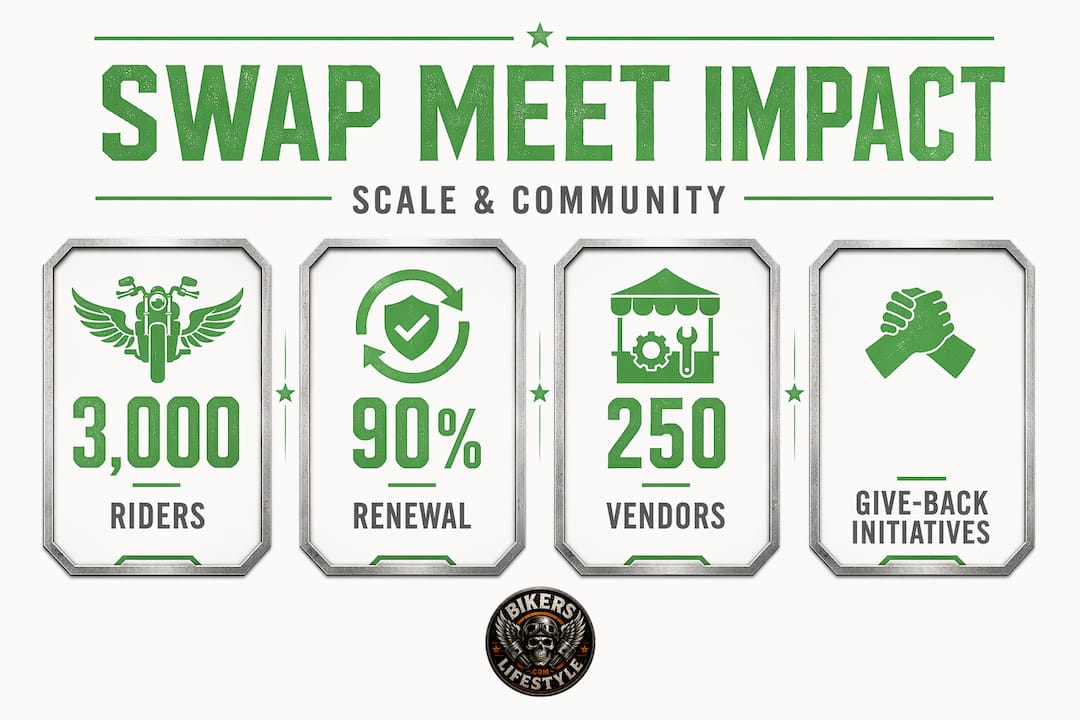
The vintage motorcycle swap meet space also generates revenue that feeds directly back into the hobby. Swap meet profits support vintage motorcycle programs including year-end awards and event funding, keeping organizations like AHRMA (American Historic Racing Motorcycle Association) running the competitions and preservation work that keep older machines alive and competitive.
| Metric | York Swap Meet (2026) |
|---|---|
| Estimated annual attendance | 2,500 to 3,000 riders |
| Vendor spaces available | 400+ |
| Vendor renewal rate | Over 90% |
| Primary beneficiary | AHRMA vintage programs |
| Parts categories covered | Vintage, classic, off-road, and custom |
That 90 percent vendor renewal rate deserves more attention than it usually gets. In any marketplace, vendor retention that high signals that sellers are making money and finding the audience worth returning to. It's not sentiment keeping them there. It's economics, and those economics directly fund the awards, races, and restoration programs that keep the vintage motorcycle world viable.
What to find at swap meets at this scale goes well beyond used carburetors. Major events carry complete bikes in project condition, new-old-stock (NOS) factory parts still in original packaging, custom fabricated components, period-correct literature and manuals, tools specific to vintage marques, and entire lots being liquidated from estates or closed shops. The inventory breadth at large events rivals anything available digitally, with the added benefit that you can see and touch everything.
Understanding the dimension and legacy of swap meets, let's now explore practical strategies to get the most value as an attendee.
How to maximize your swap meet experience: expert tips
Knowing why bikers attend swap meets is one thing. Knowing how to work one effectively is where most casual attendees fall short. The difference between a frustrating morning and finding exactly what you need often comes down to preparation and timing.
- Arrive when the gates open. Arriving early gives access to the best inventory before peak buying. Vendors set up before dawn, and the most desirable, rarest pieces are picked over within the first 90 minutes. If you show up at noon, you're shopping the leftovers.
- Bring cash, and bring enough of it. The majority of vendors do not run card readers. Some do, but you cannot count on it. Showing up with cash also gives you negotiating credibility. Pulling a wad of bills out when making an offer lands differently than asking if a vendor accepts Venmo.
- Bring measuring tools and reference parts. Successful buyers test-fit components and personally assess condition to avoid hidden issues. A small tape measure, calipers, and the specific part you're trying to match will save you from the second most common mistake: buying the wrong thing because you were sure it would fit.
- Talk to every vendor in your area of interest, even if they don't have what you need. Vendor networks are dense. The guy selling Triumph parts might know exactly who two rows over has the BSA crankshaft you've been hunting for six months.
- Build vendor relationships for the long term. Get contact info from vendors who specialize in your bike's make or era. Many hold inventory they don't bring to events. Your name in their phone can get you a call before that rare piece ever reaches a table.
- Dress for the environment. Major swap meets are outdoor events covering significant ground. Wear comfortable shoes, dress in layers for early morning temperatures, and bring a bag or small cart for anything you buy. A backpack and a folding cart are standard gear for experienced attendees.
- Know your prices before you go. Check current online sold listings for the specific parts you're hunting. Knowing that a particular carburetor sells for $180 online means you can confidently negotiate from that reference point and recognize a genuinely good deal.
Pro Tip: Read the practical swap meet strategies from riders who have worked these events across multiple seasons. Real-world patterns like which vendor rows tend to carry which categories, and when vendors are most willing to negotiate, are the kind of intel that makes a meaningful difference in your haul.
With these practical strategies, you're equipped to attend confidently. Finally, let's reflect on why swap meets continue thriving despite digital alternatives.
Why swap meets remain vital in the digital age: a fresh perspective
Here's the argument you won't hear often: swap meets aren't surviving the digital age despite their format. They're thriving because of it.
Every year that online marketplaces get more saturated with inaccurate listings, inflated prices, and misrepresented conditions, the value of a physical, face-to-face transaction goes up. The swap meet is essentially a trust mechanism in a low-trust era. When you hand over cash for a part you've personally inspected, from a vendor whose name you know and whose table you'll see again next year, you're accessing a level of transaction security that no escrow service or buyer protection policy has fully replicated.
Interest in "analog, hands-on shopping" has surged among DIY mechanics who distrust online listings. This isn't a boomer phenomenon. The growth is showing up most noticeably in younger riders in their 20s and 30s who learned the hard way that a great-looking online listing can be a complete waste of money. They're coming to swap meets not out of nostalgia but out of rational self-interest.
The economic argument is similarly practical, not sentimental. Yes, you can find parts online. But the combination of price, immediacy, physical verification, and the ability to negotiate on the spot creates an economic value that online platforms genuinely cannot replicate for anything mechanical. A 40 percent price difference is real money. The ability to avoid a bad purchase entirely through physical inspection saves even more.
What critics of swap meets often miss is that the community dimension isn't a soft benefit. It's a functional one. The insider perspectives on swap meets consistently highlight that the vendor relationships, community knowledge, and informal networks built at these events directly accelerate restoration projects in ways that Google searches cannot. Knowing the right person beats knowing the right search term, every single time.
Swap meets also represent something rare in modern consumer culture: a market that self-regulates through social accountability rather than platform algorithms. The vendor who misrepresents parts doesn't get a star rating knocked down. He loses his entire customer base at that event, permanently. That's a more effective quality control mechanism than anything a rating system provides.
The biker events and swaps space is genuinely growing, and the reasons are structural, not accidental. As long as motorcycles require physical parts, human expertise, and community support, swap meets will remain central to the hobby.
Discover more motorcycle events and community activities
Ready to put what you've learned into action? BikersLifestyle.com is built specifically to connect riders like you with the events, groups, and community resources that keep the motorcycle world moving.
Browse motorcycle events and riding groups across the country, from local chapter rides to major rallies. Explore our vintage motorcycle showcase listings for collector events and culture deep-dives. Stay current with swap meet events and info so you never miss the next great buying opportunity in your region. Whether you're building your first project bike or your fifteenth, the community and the calendar are right here.
Frequently asked questions
Why do bikers prefer swap meets over online marketplaces for parts?
Bikers prefer swap meets because they allow hands-on inspection and negotiation, reducing risks from inaccurate online photos and inflated prices. In-person buying lets you verify condition, test-fit components, and access hard-to-find parts that rarely appear online.
How do swap meets benefit the motorcycle community beyond sales?
Swap meets strengthen community by fostering trust, sharing knowledge, and funding vintage motorcycle programs and events through their profits. Swap meet proceeds directly support organizations like AHRMA, keeping vintage racing and preservation programs active.
What are some tips for a successful swap meet visit?
Arrive early, bring cash, inspect parts physically, build relationships with vendors, and prepare for outdoor conditions to maximize your experience. Arriving at opening time gives you first access to the rarest inventory before it's gone.
Are swap meets only for vintage motorcycle enthusiasts?
No, swap meets attract all riders, including those working on modern, custom, and cruiser builds alongside vintage restorations. Major events feature parts for Harleys, choppers, and Japanese cruisers in addition to classic and off-road models.