
TL;DR:
- Motorcycle formation riding prioritizes safety, communication, and trust over aesthetics, with strict discipline guiding group cohesion. Proper staggered formation ensures visibility and escape routes, while group size and communication roles influence safety and effectiveness. Adaptive formation shifts and active rider awareness are crucial for safe riding in varying conditions, emphasizing individual judgment within a coordinated group.
Most people watching a pack of motorcycles roll down the highway assume it's about attitude. Maybe tradition. Possibly just looking impressive. The reality is that why bikers ride in formation has almost nothing to do with aesthetics and everything to do with survival, communication, and the kind of trust that only develops inside a serious riding community. Formation riding is a practiced discipline with clear rules, real consequences when those rules break down, and a social layer that binds groups together in ways solo riding never can.
Table of Contents
- Understanding why bikers ride in formation: safety and spacing basics
- Why group size matters: cohesion, communication, and risks
- The role of predictability and communication in safe formation riding
- When and why formations shift: adapting to curves and conditions
- Common pitfalls and hidden risks in group formation riding
- Our take: formation riding is a skill, not a default setting
- Find your group and ride with confidence
- Frequently asked questions
Key Takeaways
| Point | Details |
|---|---|
| Staggered formation explained | Riders use staggered positions with specific spacing to increase visibility and safety during group rides. |
| Keep groups small | Small groups of 5 to 7 riders improve communication and reduce accident risks in formation riding. |
| Predictability is crucial | Holding steady lines and signaling clearly prevent dangerous chain reactions in group riding. |
| Adapt formations as needed | Switching to single-file in curves or bad conditions enhances control and rider safety. |
| Beware hidden risks | Riders must avoid herd mentality and maintain individual judgment to prevent common formation hazards. |
Understanding why bikers ride in formation: safety and spacing basics
The staggered formation is the standard for open-road group riding, and it is worth understanding exactly why. Instead of lining up single-file like a train, riders offset themselves in a zigzag pattern across the lane. The lead rider takes the left third of the lane. The second rider positions in the right third, roughly one second behind. The third mirrors the first, two seconds behind the lead. This pattern repeats down the line.
That offset is doing serious work. Each rider maintains a clear line of sight to the road ahead, not just the back tire of whoever is in front. More importantly, every rider has an independent escape path to the side if something goes wrong suddenly. If the lead rider hits debris and swerves left, the second rider can go right without collision. That is not a coincidence. That is the design.
Here is a quick breakdown of how proper staggered spacing works:
- Lead rider: positioned in the left third of the lane
- Second rider: positioned in the right third, one second behind the lead
- Third rider: mirrors the lead position, maintaining a two-second gap to the rider directly ahead
- Full-group spacing: each rider holds at least two seconds of following distance to the rider in the same lane position
| Formation element | Spacing standard | Purpose |
|---|---|---|
| Same-position gap | 2 seconds minimum | Reaction and braking time |
| Offset gap (opposite position) | 1 second minimum | Lateral escape room |
| Lane width usage | Left and right thirds only | Shared space with visibility |
| Center lane strip | Avoided | Oil buildup hazard |
Notice the center strip is off the table. That greasy center line where cars drip oil is one of the most dangerous surfaces on any road, and formation riding keeps every rider off it by default. That is one of the underappreciated motorcycle group riding tips that comes standard with proper formation discipline.
Pro Tip: If you notice the spacing compressing as your group accelerates, that is a warning sign, not a minor issue. Compressed spacing is the single fastest way to turn a group ride into a chain-reaction crash. Pick a visual cue, a road marker or a fixed gap, and hold it consciously.
The staggered pattern also helps organized motorcycle groups signal their presence as a unit to other traffic. Drivers see a wider, more visually substantial formation and are less likely to attempt lane changes through the middle of a group. Visibility to other road users is protection, and formation delivers it.
Why group size matters: cohesion, communication, and risks
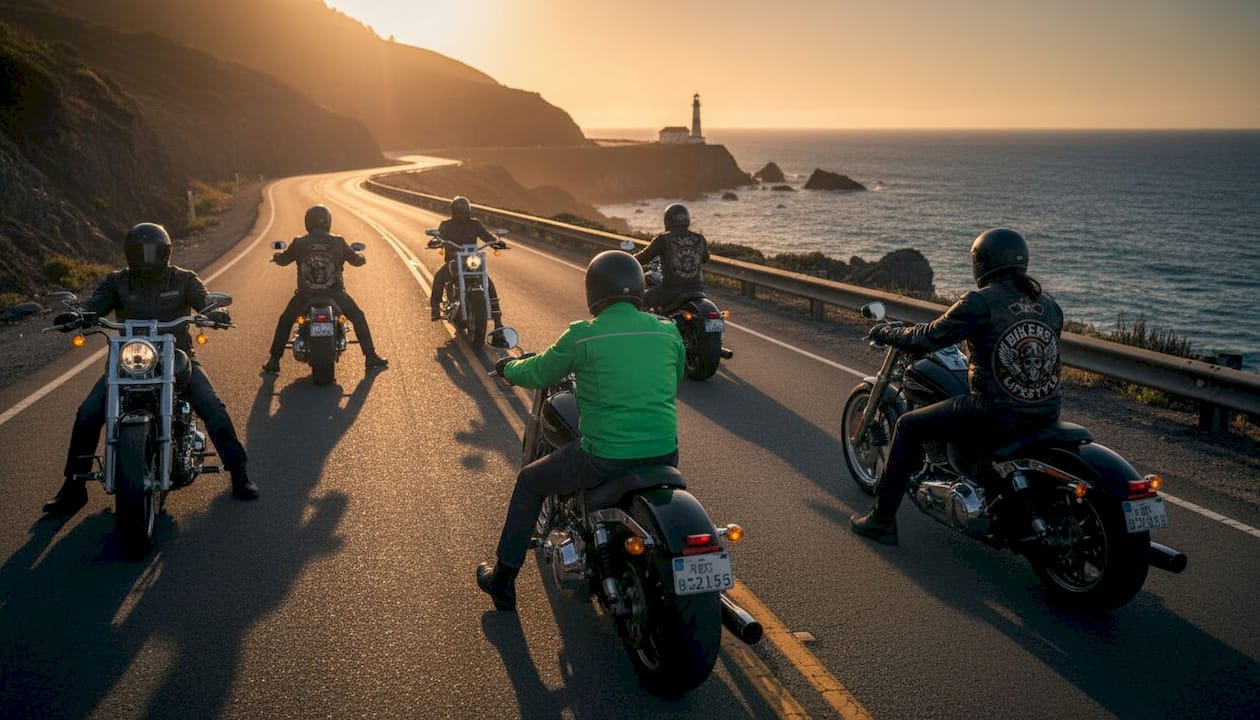
Here is something most new group riders do not expect: adding more people does not make a group safer. Past a certain number, it actively makes the ride more dangerous. Experts recommend keeping groups between 5 and 7 riders for the best balance of safety and cohesion. Beyond that, the group becomes a coordination problem.
The physics reason is the accordion effect. When the lead rider slows down, that information travels backward through the group. Each successive rider reacts slightly later and slightly harder. By the time a speed change reaches the seventh or eighth rider, what started as a gentle deceleration has become an emergency brake. Larger groups amplify this effect significantly.
The communication reason is simpler: signals get lost. A hand signal from the lead rider may pass accurately through the first four riders and then get dropped or misread by the fifth. The back half of a large group effectively operates on partial information, which is a dangerous way to navigate traffic, intersections, or sudden hazards.
Key factors affected by group size:
- Fragmentation risk: longer groups are more likely to get split by traffic lights, merging cars, or sudden stops
- Signal reliability: hand signals degrade over distance and rider count
- Reaction chain: the accordion effect lengthens in proportion to group size
- Group pressure: larger groups generate more social pressure to keep up regardless of personal comfort
Assigned roles matter here more than most riders realize. Every group needs a designated road captain up front and a sweep rider at the back. The road captain sets pace and makes route decisions. The sweep rider is responsible for no one getting left behind and for communicating problems forward. These two roles are the backbone of any well-run managing motorcycle groups setup.
Pro Tip: If your group regularly exceeds 7 riders, consider splitting into sub-groups of 5 to 7 with their own road captain and sweep. Groups can travel the same route and reunite at stops. You lose nothing except the headache of managing a group too large to function safely.
The role of predictability and communication in safe formation riding
Every crash in group riding traces back to someone doing something unexpected. That is not hyperbole. It is the consistent pattern that experienced road captains see across years of group events.
"Predictability is the golden rule; every sudden movement creates a chain reaction risk in group riding."
That blockquote deserves weight. When you ride in formation, your behavior stops being purely personal. Your sudden brake affects the rider behind you. Your unannounced lane drift closes the escape path of someone else. The social contract of formation riding requires that every move be telegraphed before it happens.
Standard communication tools used in group riding:
- Left arm straight out: turning or moving left
- Right arm bent up at elbow: turning or moving right
- Left arm bent down, palm facing back: slow down
- Left fist raised: stop ahead
- Left arm pointing down, finger pointing: hazard in road, left side
- Right hand pointing down: hazard on the right
- Left arm waved overhead in circular motion: speed up or group up
Verbal warnings also travel forward and backward through a well-practiced group. Riders shout "car back," "gravel," or "stopping" to pass information faster than signals allow. Bluetooth intercom systems have changed this significantly, especially for riding communication courses that train groups to use real-time audio communication.
The pre-ride briefing is not optional for a safe group. Thirty minutes before you roll, the road captain should cover: the route and major turns, designated fuel and rest stops, how signals will be passed, what to do if someone gets separated, and the pace for the day. Riders who understand the plan ride predictably. Riders who are guessing ride reactively, which is a hazard to everyone around them.
When and why formations shift: adapting to curves and conditions
Staggered formation works beautifully on open highway. It does not work in curves, narrow lanes, construction zones, or low-visibility weather. The mistake many groups make is treating staggered formation as the permanent default rather than a tool for the right conditions.
In a curve, each rider needs to own their lane position for proper cornering technique. The lean angle, the entry point, the apex, all of these require freedom of movement that the staggered formation restricts. Staying locked in staggered through a tight curve forces riders into compromised cornering lines and limits their ability to respond to mid-corner surprises.
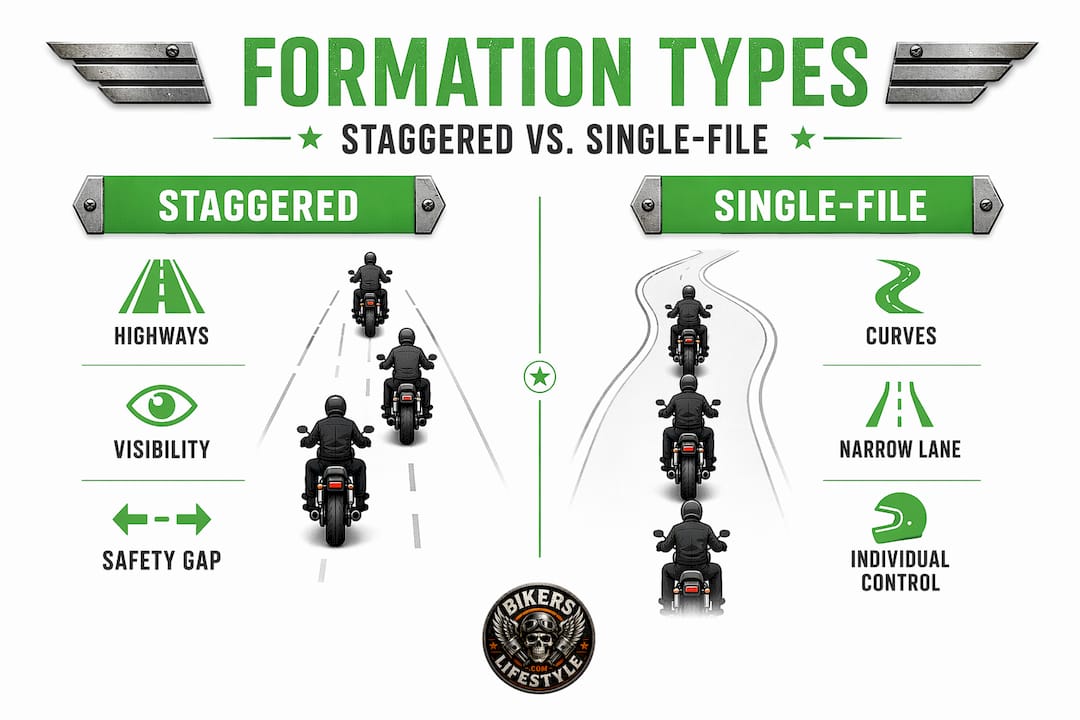
Formation must switch to single-file in curves, narrow roads, or bad weather. This is not a suggestion. It is a safety rule with a clear mechanical reason behind it.
Conditions that require a shift to single-file:
- Tight or blind curves
- Narrow lanes or bridge crossings
- Gravel, wet pavement, or ice
- Construction zones with reduced lane width
- Low-visibility conditions: fog, heavy rain, dusk
- Tunnels where lane positioning becomes critical
| Formation type | Best for | Limitations |
|---|---|---|
| Staggered | Open highways, clear visibility, straight roads | Unsafe in curves, restricts cornering lines |
| Single-file | Curves, narrow lanes, poor conditions | Reduced visibility to other traffic, longer group footprint |
| Paired (2x2) | Parades, slow ceremonial rides only | Not appropriate for traffic riding |
The signal for a formation shift needs to be clear and understood by every rider before departure. A common signal is a raised fist, followed by one or two fingers raised to indicate the new formation. Whatever system your group uses, it must be agreed on in the pre-ride briefing, not invented mid-ride.
Pro Tip: When signaling a formation shift, always signal early, before the condition arrives. Signaling at the entrance to a curve is too late. Signal 200 to 300 yards ahead so riders have time to adjust position smoothly and safely.
Check out group ride formations in different conditions to find organized rides where experienced road captains model exactly this kind of adaptive formation management.
Common pitfalls and hidden risks in group formation riding
This is where most formation riding guides stop short. They explain how to do it right, but they skip the specific failures that cause real crashes.
"The biggest hidden danger is 'risk density' and riders losing individual safety margins by blindly following the group."
Risk density is the concept that concentrating multiple bikes in close proximity multiplies the consequences of any single error. One loose wheel cover in the path of a solo rider is an inconvenience. In a tight pack of eight, it is a multi-bike incident. Formation training teaches you to maintain margins, but group social dynamics constantly pressure you to close those margins and look tidy.
Common formation pitfalls and the physics behind them:
- Half-wheeling: riding with your front wheel level with the rear wheel of the rider in your lane position. It eliminates your reaction buffer and is extremely difficult to sustain without constant speed adjustment.
- Lateral lane drift: gradually drifting toward the center of the lane collapses the offset spacing and eliminates escape paths for both you and the rider beside you.
- Herd mentality braking: following the group into a braking zone without independently judging your own stopping distance. The rider ahead of you may brake earlier or later than your own speed requires.
- Overlapping wheels: a version of half-wheeling where front and rear wheels are actually overlapping. If the rider ahead makes any lateral move, contact is unavoidable.
- Misread signals: assuming a signal was intended for everyone when it was directional, or missing a signal entirely and reacting to the group's movement instead.
The herd mentality point deserves extra attention. Experienced riders know that the impulse to keep pace with the group is one of the strongest social pressures in motorcycling. New riders especially feel it hard. They push past their comfort zone to avoid looking slow or inexperienced, which is exactly when errors happen.
Pro Tip: Your job in a group is to ride your own ride. That means you decide your braking point, your cornering speed, and your following distance. If the group's pace is pushing you outside your comfort zone, move to the back or pull over at the next stop and have an honest conversation with the road captain. That conversation is far less painful than the alternative.
Visit advanced group riding safety tips for structured training that helps riders recognize and break these patterns before they become habits.
Our take: formation riding is a skill, not a default setting
Here is what most formation guides miss because they are written for beginners who just need the basics. The most dangerous rider in a group is not the newest one. It is the rider who has done 50 group rides, never had an incident, and has decided that formation is just something that happens automatically.
That comfort breeds the exact inattention that causes crashes. Formation riding is a skill that requires active maintenance every single mile. The spacing does not hold itself. The signals do not pass themselves. The formation does not adapt to curves on its own. You adapt it, consciously, every time conditions change.
We have also noticed a pattern in the community: groups that prioritize looking good in formation often ride worse than groups that prioritize riding safely in formation. The difference is attention direction. If your focus is on maintaining a photogenic pack, you are watching the wrong thing. Your attention should be on road conditions, your spacing, incoming signals, and your own comfort level, not whether the formation looks clean from a bridge overpass.
The social side of formation riding matters too, and it is genuinely undervalued in safety discussions. When a group rides well together, there is a rhythm to it that builds trust and connection between riders. You learn how people respond under pressure. You learn who signals early, who brakes smoothly, who gets rattled in traffic. That knowledge builds bonds that last well beyond the ride itself. Formation riding, done right, is one of the most collaborative things you can do on a motorcycle.
The bottom line is this: ride the formation, do not let the formation ride you. When it serves safety, use it fully. When conditions demand you change it, change it without hesitation. And never let group pressure override your personal judgment about what is safe.
Find your group and ride with confidence
If this breakdown has you thinking about finding the right group to practice with, you are already ahead of most riders. Knowing the rules is step one. Riding with experienced road captains who model them consistently is how those rules become instinct.
BikersLifestyle.com connects you with organized riding groups in your area, upcoming group rides and rallies, and community events where you can develop your formation skills alongside riders who take safety as seriously as you do. Whether you are joining your first group ride or looking to sharpen skills you have had for years, the platform gives you the tools to find the right fit. Browse groups, plan routes, and connect with your riding community in one place.
Frequently asked questions
Why do bikers ride in a staggered formation?
Bikers use staggered formation to maximize visibility, maintain safe spacing, and give each rider a clear escape path. The staggered pattern is the accepted standard for open-road group riding because it balances visibility with lane space.
What is the ideal size for a motorcycle riding group?
Smaller groups of 5 to 7 riders are safer and easier to manage than larger ones, with better communication, less accordion effect, and lower risk of fragmentation in traffic.
When should a group switch from staggered to single-file riding?
Groups should shift to single-file when entering curves, narrow lanes, construction zones, or poor visibility conditions. Single-file riding gives each rider full control of their lane position when cornering or navigating tight spaces.
Can riding in formation replace the need for protective gear?
No. Formation improves group safety but does not protect the individual rider from injury. Helmets alone are 37 to 41 percent effective in preventing fatal injuries, which means gear remains essential regardless of how well the group rides.
What are common mistakes new riders make in group formation riding?
New riders tend to fixate on the bike directly in front of them, which causes them to miss signals and lose independent judgment about pace and spacing. The pressure to keep up is a real hazard that experienced road captains actively manage in well-run groups.